Hack the Elephant One Bite at a Time: NUL byte SQL Injection in pdo_firebird and NULL Pointer Dereference in PDO via pdo_pgsql

The PHP core and its bundled extensions are often viewed as a mature and well-hardened attack surface, but low-level implementation bugs can still slip through. In our earlier research article Hack the Elephant One Bite at a Time: JPEG-Related Memory-Safety Bugs in PHP, we showed memory-safety issues triggered during JPEG parsing in PHP.

As we continued in this direction, we launched a deeper review of PDO as a whole, along with its individual components: the DBMS-specific drivers used to connect to different backends. The scope of this work grew to the point where the analysis surfaced additional vulnerabilities in third-party dependencies. In particular, we identified an integer overflow in PostgreSQL’s client library (libpq), documented in our write-up Attack arithmetic: how an integer overflow in PostgreSQL libpq leads to denial of service. We also uncovered an information disclosure issue in the Firebird 3 client library (fbclient): when a Firebird 3 client communicates with Firebird 4 or later server versions, incorrect length values in XSQLDA fields can trigger an out-of-bounds read and expose unintended data.

However, the core outcomes of our work relate to the PDO extension’s architecture itself. During the audit, we documented a number of driver-specific behaviors and multiple flaws in how drivers interact with their target DBMSs. In this article, we take a detailed look at two representative vulnerabilities:

Through hands-on examples, we show how a deep review of key driver routines exposed serious weaknesses in the defensive mechanisms that web application developers have trusted for years.

Continue reading
Attack arithmetic: how an integer overflow in PostgreSQL libpq leads to denial of service

Databases serve as the foundation of the digital world, organizing and storing critical information: from financial transactions and medical records to website content. However, like any complex software product, they are not immune to flaws, and discovered vulnerabilities can turn this repository into a prime target for attacks. This applies in full to PostgreSQL as well—a system with a reputation as a benchmark of reliability, whose hidden issues may be no less serious than its obvious advantages.

PostgreSQL is a free, open source object relational database management system (DBMS). It stores, processes, and retrieves data using SQL, and supports modern features such as user data, stored procedures, and triggers. PostgreSQL is known for its reliability, flexibility, scalability, and ability to work with complex datasets.

libpq is PostgreSQL’s official client library designed for interacting with PostgreSQL databases from programs written in C. It is distributed as part of PostgreSQL and provides a low level API for connecting to a PostgreSQL server, executing SQL queries, processing results, and managing connections.

We identified an integer overflow vulnerability in the PQescapeInternal function, which is called by PQescapeLiteral and PQescapeIdentifier.

Continue reading

Blind trust: what is hidden behind the process of creating your PDF file?

Every day, thousands of web services generate PDF (Portable Document Format) files—bills, contracts, reports. This step is often treated as a technical routine, “just convert the HTML,” but in practice it’s exactly where a trust boundary is crossed. The renderer parses HTML, downloads external resources, processes fonts, SVGs, and images, and sometimes has access to the network and the file system. Risky behavior can occur by default, without explicit options or warnings. That is enough for a PDF converter to become an SSRF proxy, a data leak channel, or even cause denial of service.

We therefore conducted a targeted analysis of popular HTML-to-PDF libraries written in the PHP, JavaScript, and Java languages: TCPDF, html2pdf, jsPDF, mPDF, snappy, dompdf, and OpenPDF. During the research, the PT Swarm team identified 13 vulnerabilities, demonstrated 7 intentional behaviors, and highlighted 6 potential misconfigurations. These included vulnerability classes such as Files or Directories Accessible to External PartiesDeserialization of Untrusted DataServer-Side Request Forgery, and Denial of Service.

PDF generation is increasingly common across e‑commerce, fintech, logistics, and SaaS. Such services are often deployed inside the perimeter, next to sensitive data, where network controls are looser. This means that even a seemingly harmless bug in the renderer can escalate into a serious incident: leakage of documents, secrets, or internal URLs.

In this article, we present a threat model for an HTML-to-PDF library, walk through representative findings for each library, and provide PoC snippets.

Continue reading

Researching Open Source apps for XSS to RCE flaws

Cross-Site Scripting (XSS) is one of the most commonly encountered attacks in web applications. If an attacker can inject a JavaScript code into the application output, this can lead not only to cookie theft, redirection or phishing, but also in some cases to a complete compromise of the system.

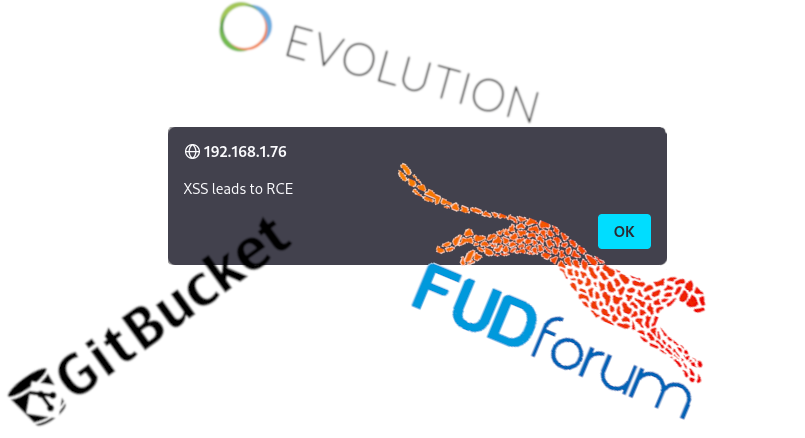
In this article I’ll show how to achieve a Remote Code Execution via XSS on the examples of Evolution CMS, FUDForum, and GitBucket.

Continue reading